

Be Like Water: A methodological journey
Oxford Water Network | School of Geography and the Environment, University of Oxford
The BE LIKE WATER Methodological Journey workshop was organised by Claudia Neuschulz, Yesim Desticioglu, Acacia Leakey, Nathan Moore, Paola Fajardo and Joe Boyle, with artist Julia Thaxton, and was supported by the SoGE Research Environment and Culture Fund. To stay connected with the Water Appreciation Society, follow @waterappreciationsociety
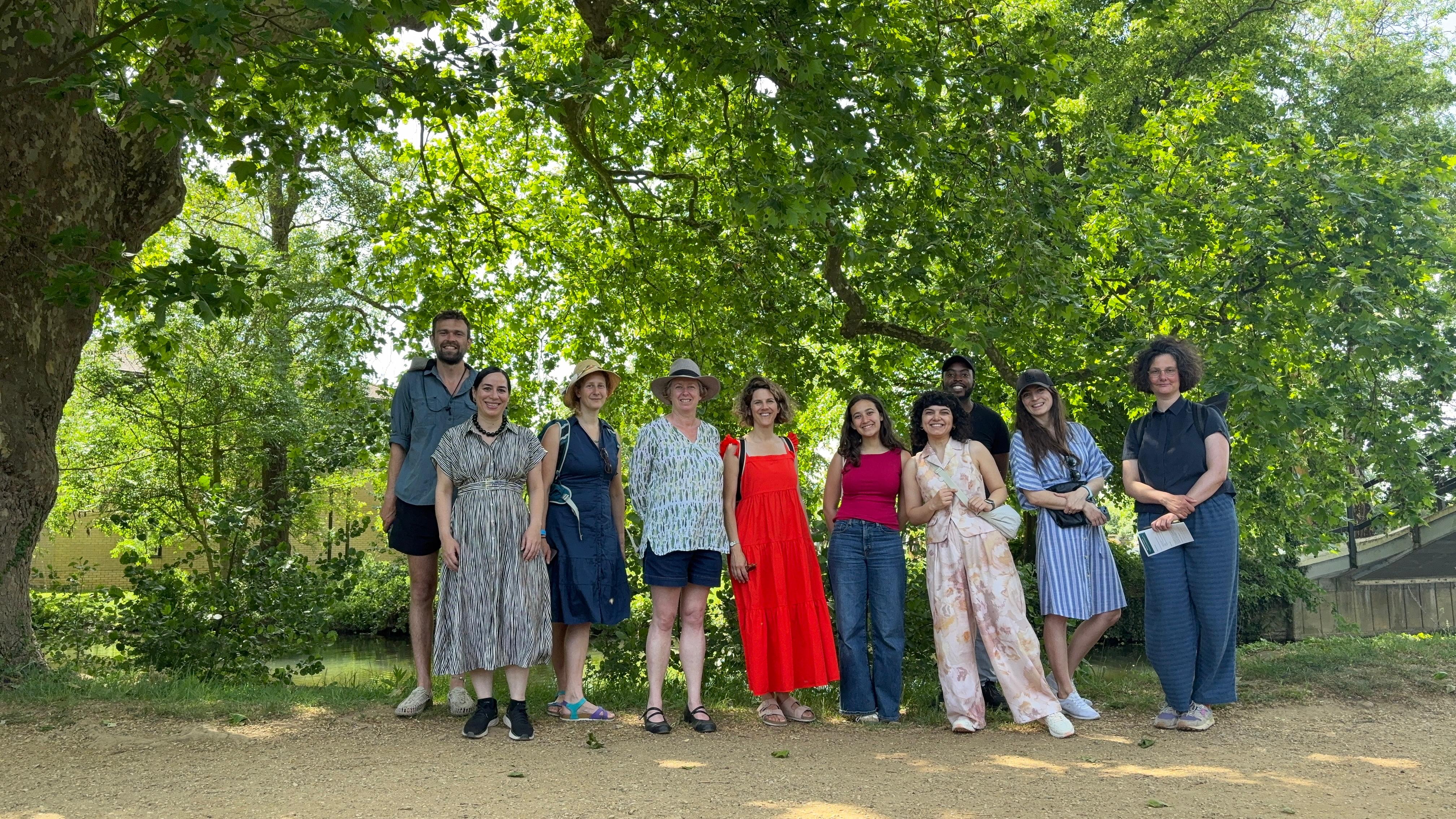
On Thursday 28 May 2026, the School of Geography and the Environment (SoGE), including Master's and DPhil students, postdoctoral researchers and senior academics gathered at Brasenose College, Oxford, for a one-day workshop titled Be Like Water: An Arts-based Approach to Water Appreciation and Creative Enquiry. Organised by a team of DPhil and Postdoctoral researchers, and supported by the SoGE Research Environment and Culture Fund, the workshop set out to explore a question that lies beyond the conventional research practice: what forms of understanding emerge when we step outside the methods we know best?
There is a question that sits beneath much of what we do as researchers: what counts as a way of knowing water? We have well-established answers to this question: surveys, modelling, interviews, remote sensing, analytical chemistry, policy analysis, all generating valuable forms of knowledge. Each method is rigorous and legitimate on its own right. Yet each also enacts a particular set of assumptions about the relationship between the researcher and the subject of inquiry. In many conventional approaches, Water, is positioned primarily an object of study — something to be measured, described and analysed from a position of relative distance. This shape how water can be perceived, understood and valued, prioritising certain forms of knowledge while leaving others less visible.
The Be Like Water workshop was organised around a different premise. Rather than approaching water as an object of study, participants were invited to engage with it as a medium of enquiry. What forms of knowledge become accessible when the distance between researcher and subject of study dissolve? What might be learned by walking alongside a river, holding its water in your hands or allowing it to move through paint across a canvas?
The day unfolded as a methodological journey through three interconnected modules, each building on the last and using water as its focal medium. Together they explored a central question: How can environmental research capture lived experience, relational values and ways of knowledge that are often overlooked by conventional research methods?
Walking with Water
The day began with a guided Water Walk through Christ Church Meadow, led by Nathan Moore, and curated by Maryam Altaf and Acacia Leakey, whose research explores walking as qualitative method. The walk followed the Oxford River Cherwell south from the gate beyond Merton Field to its confluence with the Thames, before continuing west along the river towards the Head of the River pub, and returning north through the meadow to the edge of Christ Church.
Bathed in the warm and sunshine morning during Summer VIII week, participants undertook the walk at their own pace, guided by a series of reflective prompts. Along the route, participants paused at two points to attend to different dimensions of water: its presence and absence, the sounds of flow and stillness, the boundary between managed and unmanaged landscapes, and the sensory experience of moving through the meadow as the river curved away beside them. At one point along the bank, several participants crouched down to collect water directly from the Cherwell and Thames in small jars. This water would accompany them into the afternoon’s art-based module.
What walking does, methodologically, is slow perception down. It shifts attention from the abstract to the embodied, from water as a topic to water as something happening, right here, alongside and beneath. Several participants noted afterwards that the walk surfaced observations they couldn't quite account for through language alone: a quality of light on the river, the strangeness of knowing a city was close but feeling entirely outside it.
Making as Thinking
After lunch, the group moved into a Creative Studio Session led by artist Julia Thaxton.
Julia's practice explores material process and water as medium. Her series Shaped by Water investigates what happens when water is given agency in image-making: how it carries pigment, resists control, and leaves traces of its own movement across surfaces. She brought that sensibility directly into the room.
Each participant worked on small-format canvas pieces, using acrylic paint, sand, water, and palette knives. The constraint was deliberate: no paint brushes. The river water collected on the walk became part of the making. Participants were invited not just to depict water, but to work with it, letting the water mix with paint and sand on the canvas surface, tilting the board, watching where it went.
The aim was not a finished artwork but a process of thinking through making: translating what the walk had surfaced, sensation, attention, feeling, into material form. What becomes visible when you stop writing and start mixing? What does the material do that language doesn't?
The resulting pieces were as varied as the participants. Several participants worked instinctively, responding to what the paint did rather than directing it. Others worked from a specific visual memory of the walk. A few found that the constraint of one colour, paradoxically, opened things up, freed from compositional decision-making, they could attend to texture and flow.
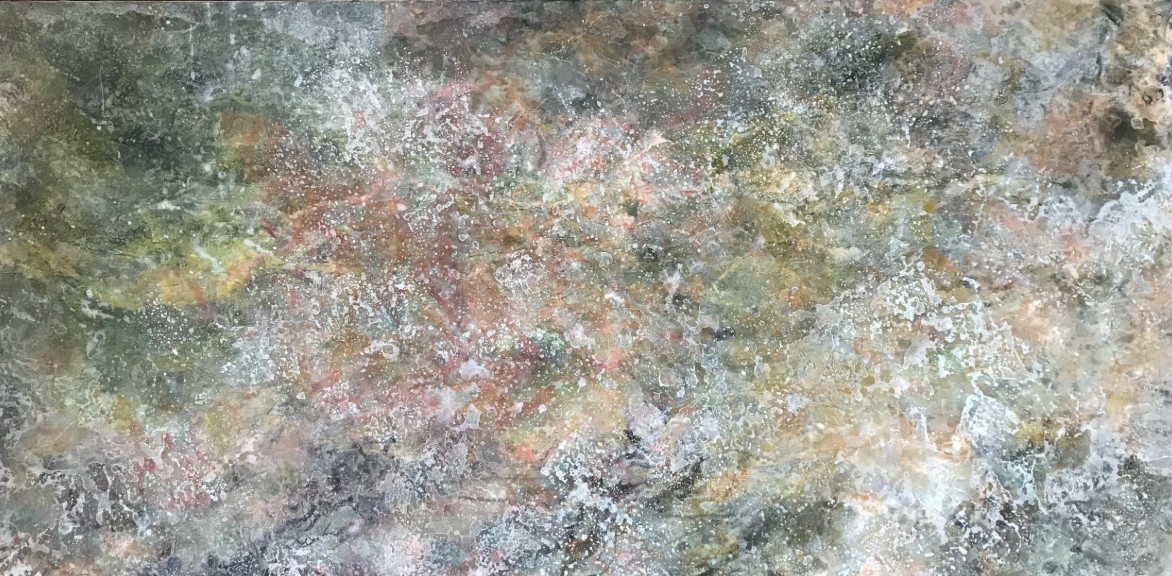
Flow by Julia Thaxton, reproduced with permission from the artist (juliathaxton.com)
Scientists as Artists: A Rare Books Interlude
Before the Reflection Circle, the group gathered around a display brought by the Brasenose Rare Books Cataloguer, Sophie Floate.
The first was a copy of De Historia Stirpium, published in Basel in 1542 by the German botanist Leonhart Fuchs. A massive folio covering around 497 plants, it was illustrated by over 500 woodcuts drawn from life, a standard of botanical illustration that has lasted to the present day, and more than 100 species were illustrated for the first time. Fuchs was a physician primarily, not a botanist in the modern sense. His careful, repeated, direct observation of living plants, translated into image.
The second was a large atlas from the 1680s, open to a map of the River Rhine, a cartographic rendering of water as territory, scale, and movement. Water here is not felt but measured, not experienced but bounded.
The third book was the most remarkable. Maria Sibylla Merian (1647–1717), was a German-born naturalist and artist known for her illustrations of insects and plants. She was the first artist to study and breed the insects she depicted. Goethe praised Merian for her ability to move "between art and science, between nature observation and artistic intention". Her De Europische Insecten depicted insects through their full life cycles alongside the plants they fed on, observation and image inseparable, the science legible only through the art. A copy held in the Brasenose collection sat open on the table, its hand-coloured plates still startling after three centuries.
Their knowledge was produced through looking, drawing, and caring about what they saw. The question hanging in the room was one the whole workshop had been circling: what did we lose when those practices were separated? And what might we recover?
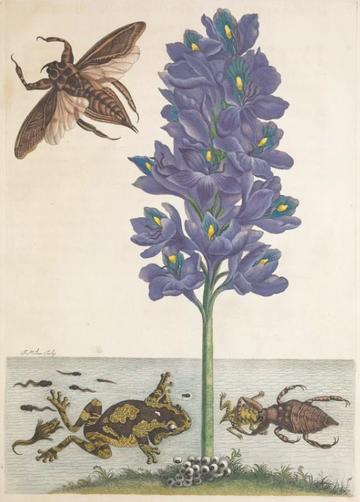
Water Hyacinth from De Europische Insecten by Maria Sibylla Merian (1647–1717) (Public domain)
Reflection Circle and Knowledge Co-creation: Shared Experiences and Participatory Mapping Activity
The afternoon concluded with a facilitated Reflection Circle led by Paola Fajardo and Joe Boyle, which brought participants together to reflect on the day's experiences and explore the methodological insights that had emerged throughout the workshop.
Paola Fajardo opened the session with a short introduction to Participatory Action Research (PAR), outlining its core principles of collaboration, the co-production of knowledge and collective learning. Rather than positioning participants as subjects from whom knowledge is extracted, PAR seeks to involve people directly in the research process, recognising them as active contributors to shaping research questions, informing methods and co-creating knowledge.
Paola reflected on how participatory approaches can help researchers engage more meaningfully with lived experience, local knowledge and relational values that are often difficult to capture through conventional research methods. She also highlighted the potential of participatory research to bring diverse knowledge systems into dialogue, creating opportunities for different ways of knowing and understanding the world to inform one another. In doing so, participatory methods can enrich environmental research by opening space for perspectives, experiences and forms of expertise that might otherwise remain marginalised or overlooked.
During the session, Yesim Desticioglu presented drawing as an analytical research method, illustrating its potential through examples from her own research. She discussed how drawing is not simply a way of representing what researchers see, but a way of observing, analysing and producing knowledge. Whether used in the field or during interviews, she suggested that drawing can slow attention, reveal relationships that might otherwise remain unnoticed, and help participants communicate memories, experiences and meanings that are difficult to express through words alone. In this sense, drawing becomes both a method of inquiry and a form of visual elicitation.
Paola Fajardo and Joe Boyle introduced the session's unexpected centrepiece: a participatory mapping exercise grounded in principles associated with participatory and action-oriented research and informed by their own experiences of working collaboratively with local communities on the conservation and restoration of coastal ecosystems. Drawing on these experiences, they reflected on how participatory methods can help surface local knowledge, strengthen community engagement and support more inclusive approaches to environmental decision-making and stewardship.
Working in groups of up to six, participants collaboratively mapped Oxford's rivers and wetlands, adding landmarks, habitats, memories, emotions, activities, stories and values associated with Christ Church Meadow and the wider riparian landscape. The exercise had not been announced in advance. This was a deliberate methodological choice to preserve the immediacy of participants' observation from the walk, undistorted by foreknowledge of what was coming, and to allow insights to emerge from direct experience rather than from anticipation of a research task. In this sense, participants were not simply responding to a predefined framework; they were actively shaping the knowledge being produced.
The resulting maps were layered, sometimes contradictory, and strikingly alive. Different participants attached significance to entirely different places, highlighting how experiences of the same landscape can vary according to personal histories, sensory encounters and emotional connections. Some annotations focused on ecological features and habitats, while others captured memories, feelings of tranquillity, moments of curiosity, or observations made during the morning walk.
As participants compared and discussed their contributions, the exercise became not only a means of documenting experience but also a process of collective interpretation. The maps revealed water not simply as a physical resource or environmental object, but as something embedded within social relationships, cultural meanings and lived experience. In doing so, they demonstrated how participatory methods can complement more conventional environmental research approaches, helping to capture diverse perspectives and forms of knowledge that might otherwise remain unseen.
Perhaps most importantly, the activity invited participants to step into the role of research participants themselves. For many, this offered a valuable opportunity to reflect on the experience of contributing knowledge rather than eliciting it. By occupying both roles—researcher and participant—they gained insight into the dynamics of participation, representation and knowledge co-production, enriching their understanding of what it means to conduct inclusive and reflexive research. In this sense, the exercise was not only about generating knowledge of water and place, but also about expanding participants' methodological imagination as researchers. Together, these activities created a space for dialogue, collective interpretation and the collaborative co-production of knowledge.
What the Day Was About
At the opening, the organising team recalled a question from an earlier planning conversation: Are we teaching methods? Discussing methods? Or practising methods?
The answer the workshop proposed was: exploring methods together. And that distinction, between transmission and exploration, between instruction and enquiry, turned out to matter more than expected.
The day was not a critique of conventional research methods. It was an invitation to be open and curious. Walking, making, and mapping produced observations that interviews and surveys would not have reached, not because those methods are inadequate, but because embodied, sensory, and creative encounters open different channels of attention and for researchers to become participants in exploring methodological approaches. What struck us most was hearing participants name their own discomfort, the unfamiliarity of drawing instead of writing and measuring and on what it feels like to sit on the other side of the research process, as a participant.
The question the workshop left open is how those channels might be integrated, systematically and rigorously, into the research practices that participants carry back into their own fields.

